Meeting minutes keep the decision. They lose the why.
Your minutes are all there — dated, attributed, decisions listed — yet six months later nobody can say why a call was made. On why this happens to well-documented teams, and how to keep the reasoning and surface it at the right moment.
Your meeting minutes are usually all there. A date, a list of attendees, decisions in neat bullet points. Procedurally, nothing is wrong. And yet six months later the same question comes back: "wait — why did we decide it this way?"
It isn't that the record is missing. The record exists. The "why" just isn't in it.
What minutes quietly throw away
Picture the shape of a typical minutes template. It's usually this:
- Decisions: go with option A / hold prices / defer this feature
- Action items: who does what, by when
- Next: date of the next meeting
What survives cleanly is the conclusion and the owner. A meeting exists to decide and to assign, so the format is optimized for exactly those two things.
What falls out is everything just upstream. Why option A? What were B and C weighed against, and on what grounds were they dropped? Which constraints and assumptions were doing the work? At the moment of the decision everyone in the room knows all of this, so none of it gets written down. "Decision: go with option A" compresses the full context into one line — and the context evaporates.
Minutes aren't failing to record. They are discarding the "why" by design.
The better-documented the team, the bigger the blind spot
The awkward part is that this happens to teams that keep good minutes, not to teams that skip them.
When there's no record at all, people recognize it as a problem — so they introduce minutes. But once minutes become routine, a sense of "it's all written down" sets in, and it gets harder to notice that the why was never in there. The folder holds hundreds of well-formed minutes, and the moment you actually need the reasoning behind a past call, it's nowhere.
Volume of records does not guarantee preservation of context.
What a why-less record costs you
Reasoning left out of the record comes back in three forms:
- Re-litigation: a settled question reopens. The minutes say only "go with option A," so nobody can reconstruct the original reasoning, and the debate restarts from zero.
- Re-learning: "we looked at this before and passed on it" never gets shared. With the reason for dropping it gone, the same option gets seriously reconsidered all over again.
- Tribal knowledge: "the only people who know why we decided that were the ones in the room." When they move on, the minutes remain but the context leaves with them.
The problem isn't missing information — it's unpreserved decision context. That's a question of what you write down before it's a question of search.
Add one line of "why" next to the decision
The fix is simple. When you write a decision, put one line of reasoning next to it.
Decision: pull the new feature's launch forward to July Why: to lock in staffing before the busy season
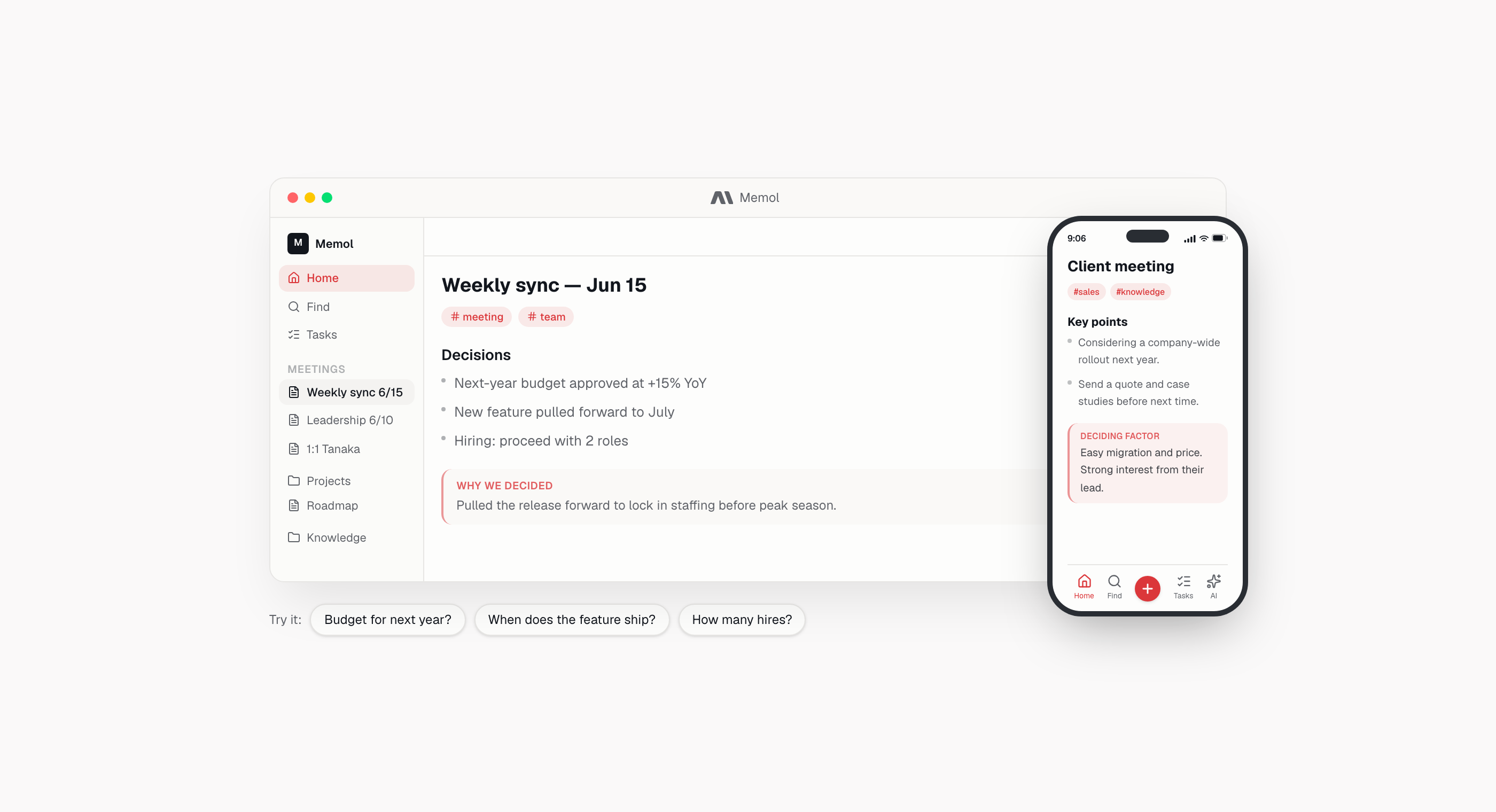
That single line lets the minutes answer their own "why did we do this again?" six months later. You don't need it on every decision — it pays off most on the kind that keeps coming back:
- Product / spec calls — why this design; what was rejected and why.
- Pricing and terms — the basis for discounts and exceptions.
- Customer-response policy — the principle you decided to answer with.
- Operational trade-offs — the approach taken and the option dropped.
Which "whys" are worth keeping is covered more broadly in Why the "why" behind a decision is the first thing to disappear.
Writing it down isn't enough if it never resurfaces
But one extra line isn't enough on its own. If that line never appears when you need it, it just sinks to the bottom of a few hundred minutes.
People don't stop mid-decision to search old minutes. So records built on "we'll look it up later" mostly go un-looked-up. Search shouldn't be something you go and do afterward — it should show up at the moment you decide.
Memol is built to connect those two things. The one-line "why" you added to a meeting note gets surfaced by AI when you're later writing about something related. You write; the assistant remembers. The small "why" sitting next to a decision is what helps the team you'll have in six months.
Memol is free for up to five people. Start with your next set of minutes — add a single line of "why" beside each decision — and see what it's worth.
Related Articles
Why the “why” behind a decision is the first thing to disappear
Teams rarely lack information — they lose the reasoning behind a decision. On how the 'why' quietly evaporates, and why keeping the reasoning (not just the conclusion) and surfacing it with AI at the right moment is what matters.
Jun 14, 2026TipsSearch should happen at the moment of the decision, not later
There are plenty of team knowledge tools, so why do past notes go unused? On the limits of designing around organizing and searching, and how AI and MCP bring retrieval into the moment a decision is made.
Jun 10, 2026TipsFound a great tool? Now get it adopted internally — a bottom-up rollout guide
Finding a useful tool is easy; getting your team to adopt it is a different skill. A practical, bottom-up playbook: trial with real data, talk cost per seat, get ahead of IT/security, and propose it on a single page — with a ready-made internal proposal you can save as a PDF.
Sep 16, 2026